
Claude Code Pricing Explained for Pro, Max and the API
Claude Code costs $20 a month on Pro, $100 or $200 on Max, or pay per token on the API. Current prices, limits, a worked cost example and how to pick.
Claude Code costs $20 a month on the Pro plan, $100 or $200 a month on Max, or nothing up front if you pay per token through the API. The free Claude plan does not include it. Those prices come from Anthropic's pricing page.
We run Claude Code all day, on two Max 20x plans, to build and fix the sites and apps we write about here. So this is not a price list copied from a press release. It is what each plan buys you, where the hidden costs are, and which one to pick.
Before anything else, the quick points.
- Pro is $20 a month, or $17 a month billed yearly. It is enough for light daily coding.
- Max is $100 for 5x the Pro usage, or $200 for 20x. It now comes with $100 or $200 of API credits each month.
- Team seats run $25 or $125 a month each when billed monthly, and less when billed yearly.
- The API has no monthly fee. Anthropic's own docs put the typical spend at about $13 per developer per active day.
- Your usage is shared. Chat, desktop, mobile and Claude Code all draw from one pool on every plan.
Inside This Post
7 sections
Every Plan That Includes Claude Code
All prices are US list prices before tax, as shown on claude.com/pricing on October 13, 2026. The Max split comes from Anthropic's Max plan help page.
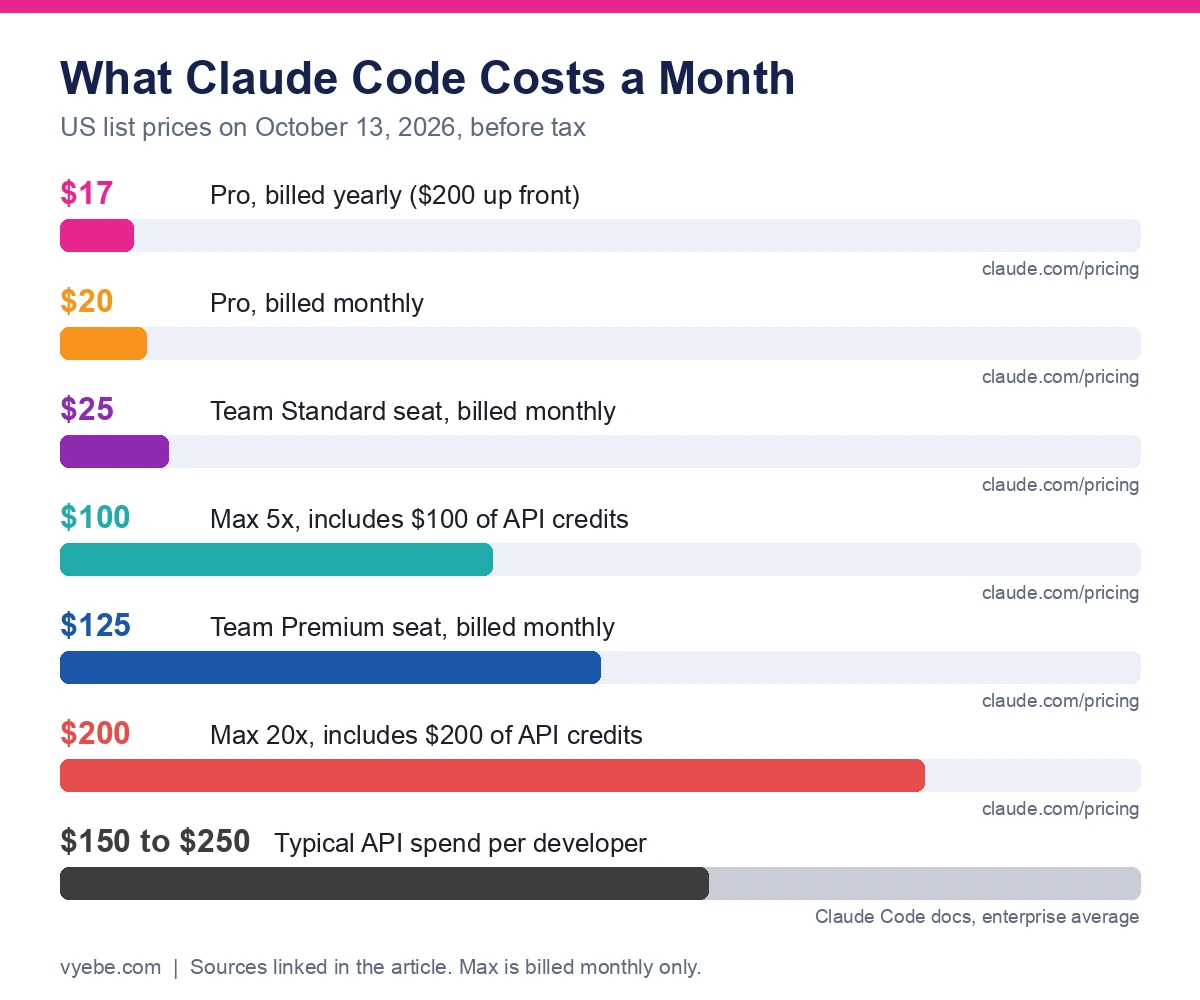
| Plan | Price | Claude Code | Usage |
|---|---|---|---|
| Free | $0 | No | Everyday questions only |
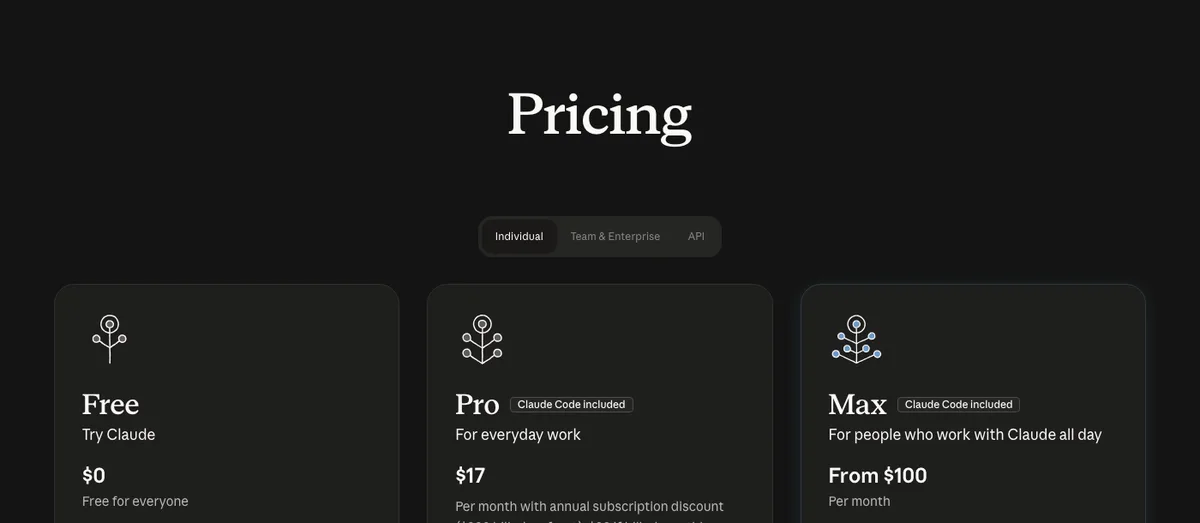
| Pro | $20 a month, or $17 a month billed yearly ($200 up front) | Yes | At least 5x Free per 5 hour session |
| Max 5x | $100 a month | Yes | 5x Pro per 5 hour session, plus $100 a month in API credits |
| Max 20x | $200 a month | Yes | 20x Pro per 5 hour session, plus $200 a month in API credits |
| Team Standard | $25 a seat monthly, or $20 billed yearly | Yes | More than Pro |
| Team Premium | $125 a seat monthly, or $100 billed yearly | Yes | 5x a Standard seat |
| Enterprise | $20 a seat a month billed yearly, plus usage at API rates | Yes | Admins set spend limits |
| API (Console) | No monthly fee | Yes | Pay per token |
A few things on that table are easy to miss.
Max has no yearly discount. The pricing page says both Max options are billed monthly.
Team is for 2 to 150 people. A Team plan also comes with up to $500 a month in pooled API credits, per the same page.
The free plan is a hard no. Anthropic's setup docs say the free claude.ai plan does not include Claude Code access. You need Pro, Max, Team, Enterprise or a Console account.
How the Usage Limits Work
This is where most of the confusion lives. Nobody on a plan gets a fixed number of messages.
Anthropic's pricing FAQ says usage resets on a rolling five hour session window. Paid plans add weekly limits on top of that. How far a session goes depends on how long the chat is, which model you pick and which features you use.
Three rules matter most for coding.
- One pool for everything. A long chat in the browser eats into the same allowance as your terminal work.
- Model choice moves the meter. Opus burns through a session faster than Sonnet. Fable, the top model, is not in Pro at all except through paid usage credits. On Max it can use up to 50 percent of your weekly limit.
- You can pay to keep going. When you hit a limit on a paid plan, you can turn on usage credits and keep working at standard API rates. Or you can wait for the reset.
The Claude Code cost docs add one quiet detail. Your prompt cache lives for an hour on a subscription. Once you start drawing on usage credits, it drops to five minutes. A short coffee break can then cost you a full reread of your project.
What the API Costs Per Token
If you sign in with a Console account or an API key, there is no plan. You pay for every token, in and out. These are the current rates per million tokens from claude.com/pricing on October 13, 2026.
| Model | Input | Output | Cache read | Cache write |
|---|---|---|---|---|
| Fable 5.1 | $10 | $50 | $0.25 | $12.50 |
| Opus 5.5 | $4 | $20 | $0.20 | $5 |
| Sonnet 5.5 | $2 | $10 | $0.10 | $2.50 |
| Haiku 5.5 (prompts up to 100K tokens) | $0.10 | $0.50 | $0.01 | $0.125 |
Three modifiers change the bill. Batch work saves 50 percent. US only processing costs 1.1x. Fast mode on Opus 5.5 is up to 2.5x faster at 2x the price.
Many guides on this topic still list last year's Opus and Sonnet rates. If a page quotes $15 per million output tokens for Sonnet, it is out of date.
A Worked Example
This is a worked example, not a bill. Say one long day of coding sends 5 million cached tokens, writes 300,000 tokens to the cache, adds 50,000 fresh input tokens and gets back 150,000 output tokens.
| Cost line | Sonnet 5.5 | Opus 5.5 |
|---|---|---|
| 5M cache reads | $0.50 | $1.00 |
| 300K cache writes | $0.75 | $1.50 |
| 50K fresh input | $0.10 | $0.20 |
| 150K output | $1.50 | $3.00 |
| Day total | $2.85 | $5.70 |
Notice where the money goes. Output and cache writes cost the most. Reading the cache is cheap, which is why Claude Code leans on it so hard.
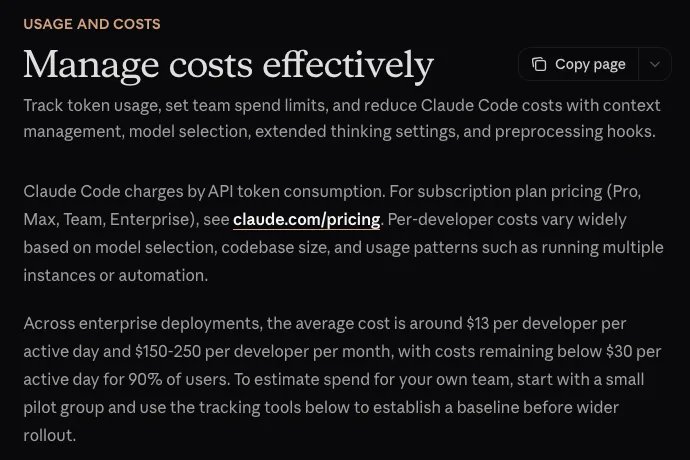
Real use runs higher. Anthropic's cost docs say that across enterprise deployments, the average is around $13 per developer per active day and $150 to $250 per developer per month. For 90 percent of users it stays below $30 per active day.
Is a Subscription or the API Cheaper?
Use the plan if you code most days. Use the API if you code in bursts or run Claude Code inside scripts.
The math is simple once you see it. If the typical developer spends $150 to $250 a month on the API, then Max 5x at $100 is already cheaper for that person. Max 20x at $200 is cheaper for anyone near the top of that range. And Max now hands you $100 or $200 of API credits on top, so the API side is no longer a separate bill for small projects.
| You are | Pick | Why |
|---|---|---|
| Trying it out, coding a few hours a week | Pro at $20 | Cheapest way in, and you can cancel any time |
| Coding most days on one project | Max 5x at $100 | Five times the room, and no surprise bills |
| Running long agent sessions or several at once | Max 20x at $200 | The only individual plan that keeps up |
| A team of 2 to 150 | Team, Standard seats for most, Premium for heavy users | Mix seat types, central billing |
| Running Claude Code in CI or scripts | API with a workspace spend limit | You pay only for what runs |
| A big company with compliance needs | Enterprise | Spend controls, audit logs, SCIM |
The Trap That Costs People Money
Claude Code checks for an ANTHROPIC_API_KEY on your machine. Per the authentication docs, if you have a subscription and that key is set, Claude Code uses the key once you approve it. In scripted runs with claude -p, it uses the key whenever one is present, with no prompt at all. Either way, the tokens bill your API account, not your plan.
If you pay for Pro or Max, run /status in Claude Code to see which login is active. If it is the API key, run unset ANTHROPIC_API_KEY and start Claude Code again to fall back to your subscription.
How to Spend Less on Claude Code
These come from Anthropic's cost docs and from our own daily use. Each one saves real money on the API and real room on a plan.
- Clear between tasks. Type
/clearwhen you switch to something unrelated. Old context gets resent with every message. - Default to Sonnet. Save Opus for hard planning and tricky bugs. Switch with
/model. - Check the meter.
/usageshows your plan bars and what is eating them, including skills, subagents and MCP servers. - Turn off MCP servers you are not using. Run
/mcpand disable them. Run/contextto see what fills the window. - Keep CLAUDE.md short. The docs suggest under 200 lines. Move long how-to notes into skills, which load only when needed.
- Lower the effort on easy jobs. Use
/effortfor simple tasks. - Watch agent teams. The docs say a team in plan mode uses about 7x the tokens of a normal session.
- Be specific. "Add input checks to the login function in auth.ts" costs far less than "improve this codebase."
All of these tips point the same way. The docs say token costs scale with context size, so the bill is driven by how much you resend, not by how hard the question is. We cover why context fills up in the context problem.
Bad Advice We Keep Seeing
Most of the advice on this topic was written in June or July. Three problems keep coming up.
Old model rates. Several still list Sonnet at $3 and $15 per million tokens, or Opus at $5 and $25. Those are older models. The current Opus 5.5 and Sonnet 5.5 rates are lower.
No mention of Max API credits. Max 5x now includes $100 a month of API credits and Max 20x includes $200, per the pricing page. That changes the plan versus API math.
Made up token limits. One page claims Pro gets about 44,000 tokens per window. Anthropic does not publish a token count. It says the limit depends on the chat length, model and features, so there is no fixed number to quote.
If you are still choosing between tools, start with choosing your first AI coding tool. Our Claude Code resource page covers what it is good at and what to watch.
Still Wondering?
- How much does Claude Code cost?
Claude Code is included with Claude Pro at $20 a month, or $17 a month billed yearly. Max costs $100 or $200 a month. You can also pay per token through the API with no monthly fee. The free plan does not include it.
- Is Claude Code free?
No. The free Claude plan does not include Claude Code. The cheapest way in is Pro at $20 a month. With an API account you pay only for what you use, but there is no free tier for it.
- Is the $20 Claude Code plan worth the money?
Yes, if you code a few hours a week. Pro gives you Claude Code in the terminal, desktop app and editor, plus Opus and Sonnet. If you hit the limit most days, Max 5x at $100 is the next step.
- How much does a Claude Code subscription cost for a team?
A Team Standard seat is $25 a month, or $20 billed yearly. A Premium seat with 5x the usage is $125 a month, or $100 billed yearly. Teams run from 2 to 150 people and can mix seat types.
- What is the difference between Max 5x and Max 20x?
Max 5x is $100 a month and gives five times the Pro usage per five hour session. Max 20x is $200 and gives twenty times. Max 5x includes $100 of monthly API credits and Max 20x includes $200.
- Is Claude Code cheaper on the API or on a plan?
For daily use, a plan is usually cheaper. Anthropic's docs put typical API spend at $150 to $250 per developer per month. The API wins if you only code now and then or run it in automated jobs.
- What happens when I hit my Claude Code limit?
You can wait for the five hour window to reset, move to a bigger plan, or turn on usage credits. Credits keep you working at standard API rates until you turn them off or reach your spend limit.
Like this guide? Add Vyebe as a preferred source on Google and see more of our posts when you search.
The Paper Trail
- Anthropic, Plans and pricing, plan prices, usage FAQ and API rates, accessed October 2026
- Claude Help Center, What is the Max plan, Max 5x and 20x prices, accessed October 2026
- Claude Code docs, Manage costs effectively, per developer averages, cache lifetime and savings tips, accessed October 2026
- Claude Code docs, Advanced setup, which accounts can sign in, accessed October 2026
- Claude Code docs, Authentication, how an API key takes over from a subscription, accessed October 2026
- Superblocks, Claude Code pricing 2026, June 19, 2026, the ranking page we compared against, accessed October 2026
- Jet Admin, Claude Code pricing, July 28, 2026, compared for token limit claims, accessed October 2026
Stalled somewhere in here?
Send us the project and what's blocking you. You'll get a straight read on what's actually wrong, including if it's something you can fix yourself.
Tell us what happenedWorth Reading
Is Vibe Coding Bad? What the Evidence Says
Vibe coding is not bad for prototypes and personal tools. It is bad when unread AI code holds other people's data. The studies and breaches show why.
FundamentalsVibe Coding Best Practices for Apps That Ship
Vibe coding best practices that keep an AI built app moving past the demo. Twelve habits for planning, prompting, testing and shipping safely.