
Is Claude Code Free? No, but 4 Routes Cost Almost Nothing
Claude Code is free to install but not free to run. The free Claude plan leaves it out. Four real ways to use it for little or nothing, and the trap to skip.
The costly mistake is grabbing a "free Claude Code" proxy from a video and pointing your whole project at a server you know nothing about. Every file Claude reads goes through that server. And Anthropic's own docs say it doesn't support Claude Code on non-Claude models at all. So start with the free routes Anthropic actually offers, and only then look at cheap models you control.
Claude Code itself costs nothing to download. Running it does. Anthropic's setup docs say it needs a Pro, Max, Team, Enterprise or Console account, and that the free claude.ai plan doesn't include it. We pay for Claude Code every day to build the sites and apps we write about, so we've tried most of the ways people try to get around that bill. Every figure below links to where it came from.
Inside This Post
7 sections
What Free Actually Means Here
Two things get mixed up. One is the program. The other is the model it talks to.
The program is free to install. You can run the one line installer on Mac, Linux or Windows without paying. Our install guide walks through it.
The program is not open source. The license in Anthropic's claude-code repo reads "All rights reserved" and points to Anthropic's commercial terms. You can read the issues and the changelog there. You can't fork the agent and ship your own.
The model is what you pay for. Claude Code sends your prompts and files to a model and gets code back. Anthropic charges for its models by plan or by token.
| Plan | Price | Claude Code? |
|---|---|---|
| Free | $0 | No |
| Pro | $20 a month, or $17 a month billed yearly | Yes |
| Max | From $100 a month | Yes |
| Team, Standard seat | $25 a month, or $20 billed yearly | Yes |
| Console (API) | No monthly fee, pay per token | Yes |
Those prices are from claude.com/pricing. The full breakdown of each plan and its limits is in our Claude Code pricing guide.
Route 1. A Guest Pass for 7 Free Days of Pro
This is the cleanest free option, if you know someone who pays. Anthropic's guest pass page says eligible Pro and Max subscribers get a limited number of passes to share.
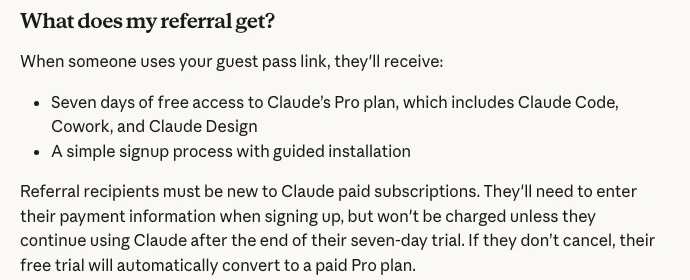
What you get. Seven days of Pro, with Claude Code, Cowork and Claude Design included.
What it asks. You must be new to paid Claude plans. You enter payment details at sign up. You aren't charged during the week, but the trial turns into paid Pro if you don't cancel.
How your friend finds them. They type /passes in Claude Code, or open the Claude Code section of their Claude settings. Passes can expire, so ask while they have some.
Put a reminder on your phone for day six. A week is enough to learn whether Claude Code fits how you work. It isn't enough to finish a real app.
Route 2. Six Months of Max if You Maintain Open Source
Anthropic runs a Claude for Open Source program that gives six months of Max 20x at no cost. At the $200 monthly price, that's $1,200 of plan.
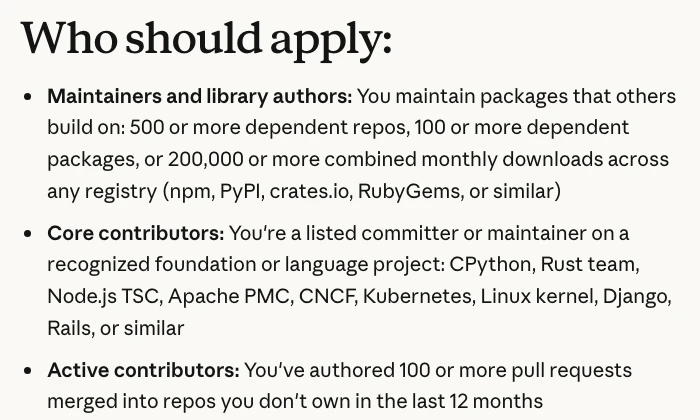
You qualify if you meet any one of these.
| Path | What Anthropic asks for |
|---|---|
| Maintainer or library author | 500+ dependent repos, 100+ dependent packages, or 200,000+ monthly downloads |
| Core contributor | Listed committer on a known project, like CPython, Rust or Kubernetes |
| Active contributor | 100+ merged pull requests in repos you don't own, in the last 12 months |
| Community builder | A repo with 20+ outside contributors in the last 12 months |
| Critical infrastructure | A repo with an OpenSSF criticality score of 0.4 or higher |
If you don't hit a number, the page says to apply anyway and explain why your project matters. When the six months end, your account drops back to the free plan unless you had a paid plan before.
Route 3. Local Models Through Ollama for $0
Claude Code reads an environment variable called ANTHROPIC_BASE_URL. Point it at a different server and it sends its requests there. Ollama's Claude Code guide uses that to run Claude Code on open models.
The fastest start is one command.
ollama launch claudeOr set it up by hand, with a model that runs on your machine.
export ANTHROPIC_AUTH_TOKEN=ollama
export ANTHROPIC_API_KEY=""
export ANTHROPIC_BASE_URL=http://localhost:11434
claude --model qwen3.5
Ollama says the model must support tools, and the context window should be 64k tokens or more for real projects. A small model with a short context will read three files and lose the thread.
The catch is support. Anthropic's gateway docs say it doesn't support routing Claude Code to non-Claude models through any gateway. It usually works. When it breaks, nobody at Anthropic will help, and features built for Claude models may fail quietly.
The second catch is your computer. Claude Code alone needs 4 GB of RAM, per the setup docs. A coding model that can handle a real repo needs far more than that. On a typical laptop, local mode is a way to learn the tool, not a way to build all day.
Route 4. Cheap Paid Models, Billed by the Token
If your laptop can't run a big model, the next step is paying a little instead of paying monthly. Two ways do it.
Anthropic's API with Haiku. Sign in with a Console account instead of a plan, and you pay only for what you use. Anthropic's pricing page lists Haiku 5.5 at $0.10 per million input tokens and $0.50 per million output tokens, for prompts up to 100,000 tokens. Sonnet 5.5 is $2 and $10. Opus 5.5 is $4 and $20.
Ollama's cloud. Ollama's pricing page lists a pay as you go tier with no subscription. GLM 5.3 Flash is $0.15 in and $0.50 out per million tokens. Kimi K2.7 Code is $0.95 and $4. Same support catch as Route 3.
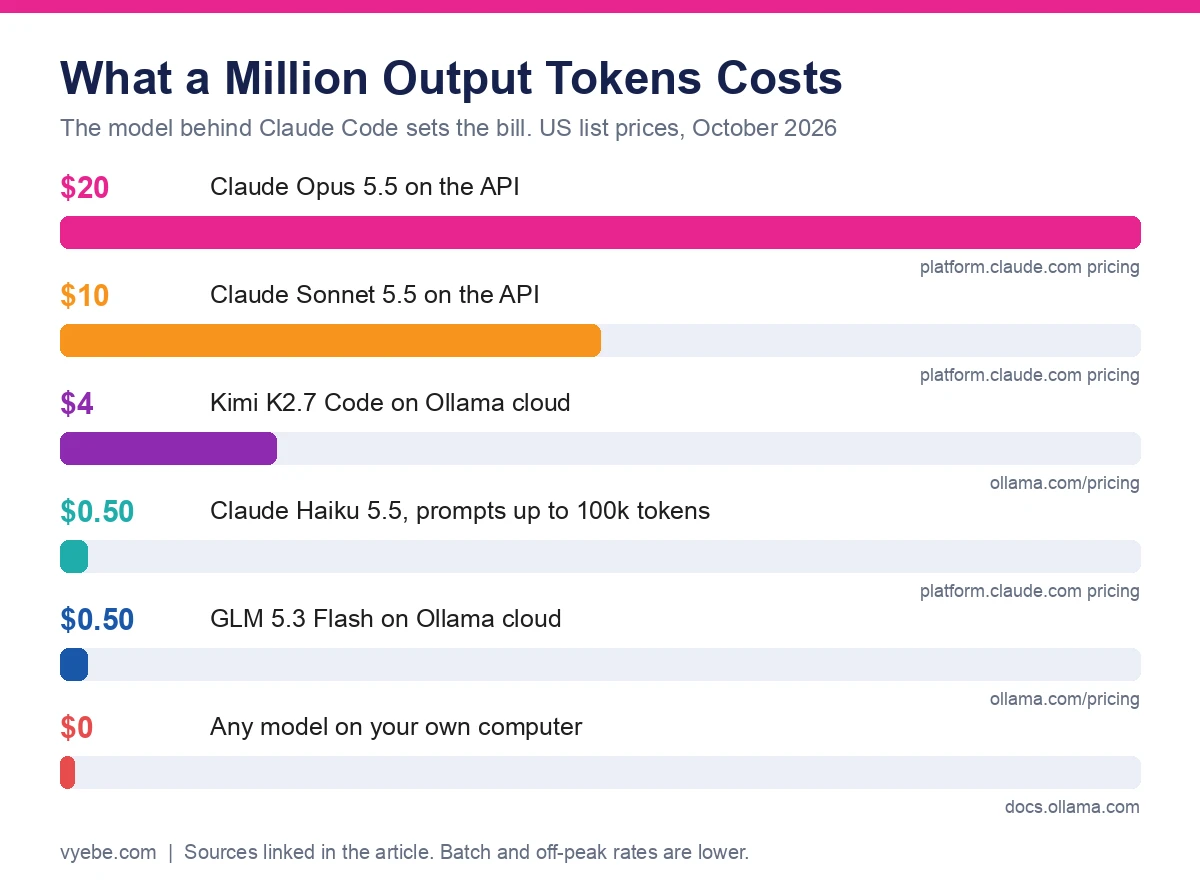
How far does a dollar go? Anthropic's cost docs show a sample /usage readout of a Sonnet session that cost $0.55. The same page puts the average enterprise developer at about $13 per active day, and under $30 a day for 90% of users. Light use on Haiku costs pennies. Heavy daily use on Opus costs more than Pro.
A few habits stretch any pay per token budget.
- Run
/clearbetween tasks. Old context rides along with every new message. - Pick the model on purpose. Use
/modeland save Opus for the hard problems. - Set a ceiling. The
--max-budget-usdflag caps what one run can spend. - Ask for one thing at a time. "Add validation to the login form in auth.ts" costs less than "improve this app."
Bad Advice We Keep Seeing
"Use this free Claude Code proxy." Some popular GitHub projects route Claude Code through free tiers of other models. Your prompts, your files and any keys in them pass through code a stranger wrote. Read every line first, or skip it. If you want a free agent, use one built for open models on purpose. Our OpenCode comparison covers the best known one.
"Claude Code is open source, so it's free." It isn't open source. The repo is public, and the license says all rights reserved.
"Just make another free account." The free plan doesn't include Claude Code, so a second free account doesn't either.
"Local mode is the same as the real thing." It's the same program talking to a smaller brain. The output depends on the model, and the docs say Anthropic won't support that pairing.
Still Wondering?
- Can I use Claude Code on the free plan?
No. Anthropic's setup docs say the free claude.ai plan doesn't include Claude Code access. You need Pro, Max, Team, Enterprise or a Console account with API billing.
- Is there a free trial of Claude Code?
Not one you can start alone. A Pro or Max subscriber can send you a guest pass for seven free days of Pro, which includes Claude Code. You enter a card, and it turns into paid Pro unless you cancel.
- Is Claude Code free for students?
There's no student discount listed for individuals on Anthropic's pricing page. The page does list an Education plan, which a university buys for its students and staff. Ask your school if it has one.
- Is Claude Code free with the Pro plan?
It's included, not extra. Pro costs $20 a month, or $17 a month billed yearly, and Claude Code shares one usage pool with Claude chat on that plan.
- Can I use Claude Code without an Anthropic account?
Yes, in two ways. You can sign in through Amazon Bedrock, Google Cloud or Microsoft Foundry and pay that cloud. Or you can point it at Ollama or another server with
ANTHROPIC_BASE_URL, which Anthropic doesn't support for non-Claude models.- Is there a free alternative to Claude Code?
Yes. Open source agents like OpenCode run on many models, including free and local ones. Our OpenCode vs Claude Code guide compares them side by side.
If a project you started on a free setup has stalled, our project rescue page is where we pick those up.
Like this guide? Add Vyebe as a preferred source on Google and see more of our posts when you search.
The Paper Trail
- Claude Code docs, Advanced setup, account requirements and system requirements, accessed October 2026
- Claude pricing, plan prices and which plans include Claude Code, accessed October 2026
- Claude Help Center, Claude Code guest passes, who can send passes and what they include, accessed October 2026
- Claude for Open Source, the six month Max 20x offer and its rules, accessed October 2026
- Anthropic, claude-code on GitHub, the license file, accessed October 2026
- Ollama docs, Claude Code, local and cloud setup, accessed October 2026
- Ollama pricing, pay as you go model prices, accessed October 2026
- Claude Code docs, Other LLM gateways, support for non-Claude models, accessed October 2026
- Claude API docs, Pricing, per token prices for Haiku, Sonnet and Opus, accessed October 2026
- Claude Code docs, Manage costs effectively, average daily cost and ways to cut it, accessed October 2026
Stalled somewhere in here?
Send us the project and what's blocking you. You'll get a straight read on what's actually wrong, including if it's something you can fix yourself.
Tell us what happenedWorth Reading
Base44 Review, Fast to a Demo and Slow to a Real App
Base44 builds a working app with login and a database from one prompt. Where it stalls, what the code export really gives you, its security record and the reviews.
Build Notes4 Ways to Use Claude Code With GitHub, and Undo Mistakes
Connect Claude Code to GitHub four ways, from plain git to @claude in pull requests and cloud sessions. Setup, real costs, and how to undo a bad change.