
OpenCode vs Claude Code, and What the Free Agent Costs
OpenCode is free and open source, Claude Code is $20 a month and up. Compare models, real costs, safety defaults and the Claude login rule before you switch.
The costly mistake with OpenCode is installing it to dodge the Claude bill, then pointing it at your Claude Pro or Max login. Anthropic doesn't allow that, and OpenCode stopped shipping the plugins that did it. Treat OpenCode as a free agent that still needs a paid brain, and pick the brain before you pick the tool.
Our own builds run on Claude Code every day, so we read both tools' docs line by line before writing this. Every figure below links to where it came from.
Inside This Post
8 sections
What Each Tool Actually Is
Both are coding agents. You describe a change, and the agent reads your files, runs commands and edits code until the job is done. The difference is who owns each layer.
OpenCode is an open source agent under the MIT license. Anyone can read the code, change it or fork it. Its provider docs say it supports 75+ model providers plus local models through tools like Ollama and LM Studio. It runs in the terminal, as a desktop app or as an IDE extension.
Claude Code is Anthropic's agent, and it only speaks to Claude models out of the box. The license file in its GitHub repo reads all rights reserved. You can't fork it. You get it through a Claude plan or an API account.
Both projects are big. When we pulled the GitHub numbers this month, OpenCode had 220,468 stars and Claude Code had 152,986. Stars measure attention, not quality, but nobody should call OpenCode a side project anymore.
One thing to know before you install. OpenCode's intro page says version 2 is out, and versions 1 and 2 both use the opencode command. They can't sit side by side under the default name, so follow one set of docs.
| OpenCode | Claude Code | |
|---|---|---|
| License | MIT, open source | All rights reserved |
| Models | 75+ providers, local models | Claude by default, other Messages API models through a gateway |
| Cost of the tool | $0 | Included with Claude plans |
| Cheapest paid path | OpenCode Go, $10 a month | Claude Pro, $20 a month |
| Default safety | Most actions allowed | Auto mode with a safety check per action |
| Project memory file | AGENTS.md | CLAUDE.md |
| Plan mode | Tab key | Shift+Tab |
What You Will Really Pay
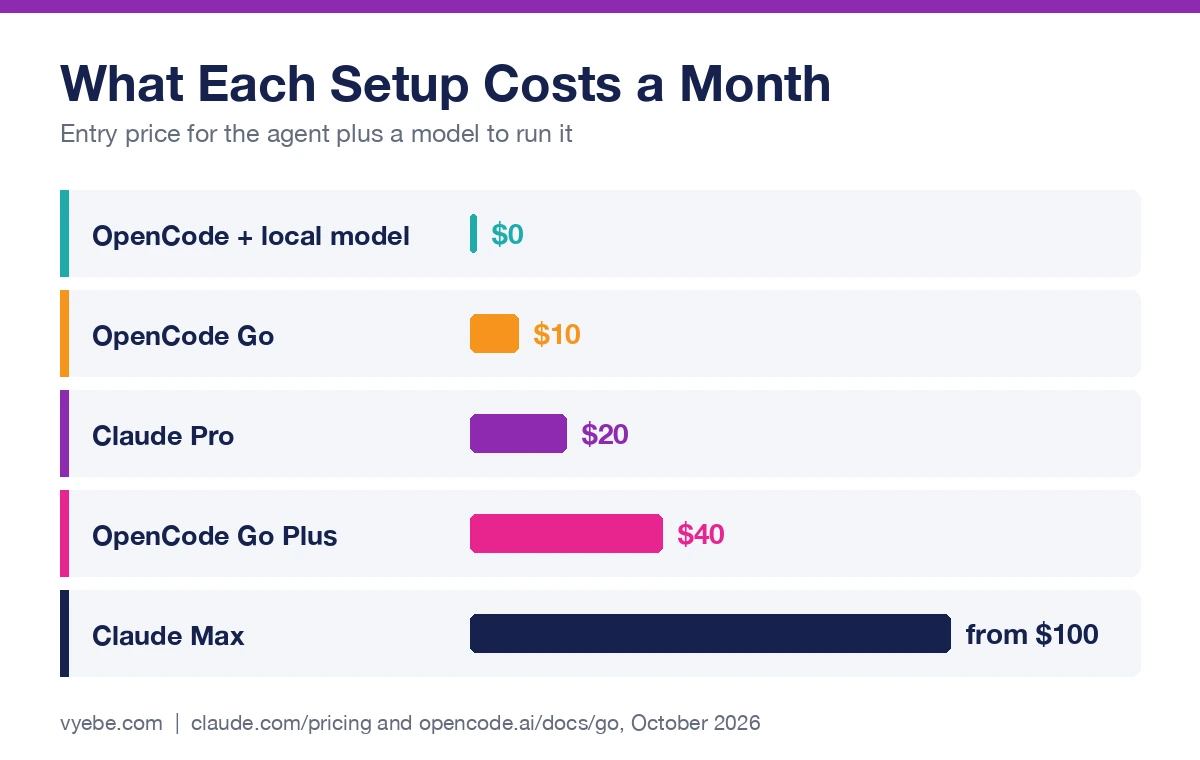
The tool price is a trick question. OpenCode costs nothing to install. The model behind it is the bill.
Claude Code. Claude's pricing page lists Pro at $20 a month, or $17 a month billed yearly. Max starts at $100 a month. The Free plan does not include Claude Code. Our Claude Code pricing breakdown covers the limits and the API math.
OpenCode with OpenCode Go. The Go docs list two plans. Go is $10 a month and Go Plus is $40 a month. Usage is capped in dollars per model, with 20% of the monthly limit usable in any 5 hours and 50% in a week. The model list includes Kimi K3, DeepSeek V4, MiniMax M3, Qwen and Claude Haiku 5.5. It does not include Sonnet or Opus. Go plans are for one person, and a workspace with Go can't invite members.
OpenCode with an API key. Bring a key from Anthropic, OpenAI or another provider and pay per token. This is the only approved way to use Claude Sonnet or Opus inside OpenCode. On a busy week, pay as you go can pass the price of a flat plan quickly.
OpenCode with a subscription you already have. The provider docs say ChatGPT Plus, GitHub Copilot and GitLab Duo plans work in OpenCode with no setup. If you already pay for one of those, OpenCode costs you nothing extra.
OpenCode with a local model. Free to run, if your computer can carry it. Expect slower and weaker results than a frontier model on a hard task.
The Claude Login Rule That Catches People
A lot of OpenCode setups broke in January because of one rule.
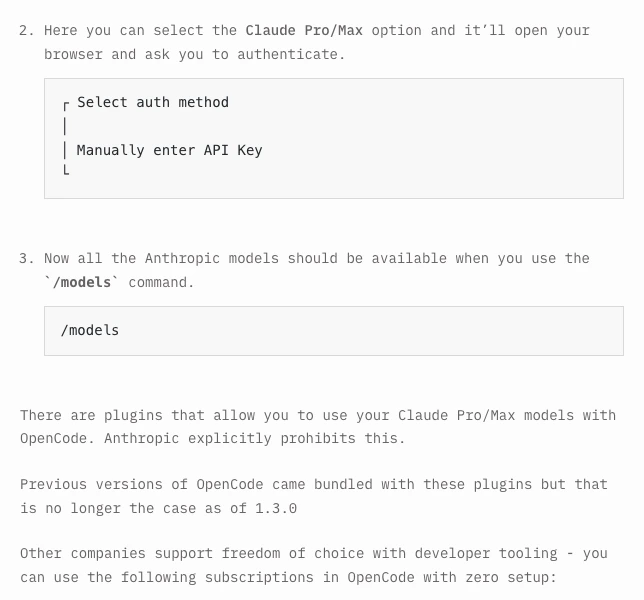
Anthropic's legal and compliance page says subscription logins are meant for Claude Code and Anthropic's own apps. It also says third party developers may not route requests through Free, Pro or Max plan credentials. Builders of other tools are told to use API keys instead.
On January 9, 2026, VentureBeat reported that Anthropic tightened its checks against tools that pretended to be Claude Code. OpenCode was the tool hit hardest. Some users were banned by automated filters, and Anthropic said it was reversing those bans.
OpenCode's own provider docs now say Anthropic explicitly prohibits the Pro and Max plugins. They also say OpenCode stopped bundling them as of version 1.3.0. Blog posts from 2025 that walk you through a Max login in OpenCode are out of date.
Safety Defaults Are Not the Same
For people who build with AI but don't read every diff, this is the difference that matters most.
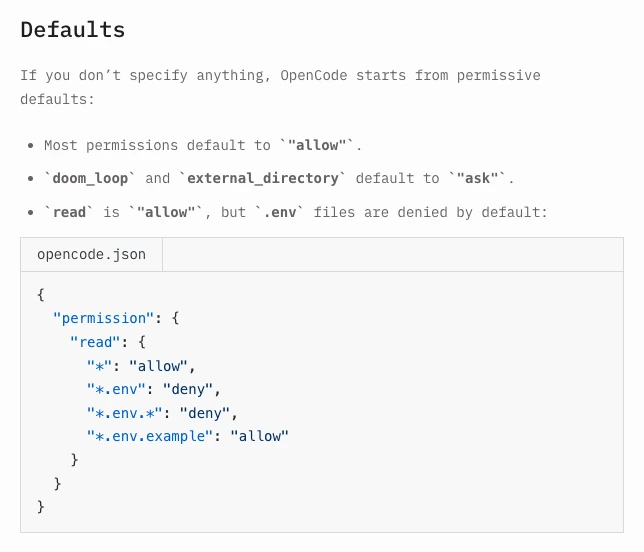
OpenCode starts open. Its permissions page says it starts from permissive defaults. Most actions are set to allow. Only repeated loops and work outside the project folder ask first. Reading .env files is denied by default, which is a nice touch. You can tighten it with allow, ask and deny rules per command, and opencode --auto approves anything not denied.
Claude Code starts checked. Anthropic's permission modes page says auto mode is the starting mode for terminal and VS Code sessions from version 2.1.283. In auto mode a second model reviews each action before it runs. Manual mode asks you before most edits, shell commands and network calls. Bypass mode is meant for throwaway containers only.
Neither default is wrong. A developer who reviews every change will enjoy OpenCode's speed. A first timer building a real app with customer data should copy this OpenCode starter rule before the first session.
{
  "$schema": "https://opencode.ai/config.json",
  "permission": {
    "*": "ask",
    "shell": { "*": "ask", "git status": "allow", "git diff *": "allow", "rm *": "deny" },
    "edit": "ask"
  }
}
Save it as opencode.json in the project folder. It turns OpenCode into an agent that asks, which is closer to how Claude Code behaves on day one.
Mixing the Two Works
You don't have to pick a side forever.
Claude Code on cheaper models. OpenCode's Claude Code harness page shows how to point Claude Code at OpenCode Go by setting ANTHROPIC_BASE_URL. Only models that accept Anthropic's Messages format work there. On Go that means Claude Haiku 5.5, Kimi K3, DeepSeek V4, MiniMax M3 and Qwen. Changing the base URL turns off Claude Code's Remote Control, which needs Anthropic's own API. Our Remote Control guide explains why.
OpenCode on Claude. Use an Anthropic API key, not a Pro or Max login. You keep OpenCode's open interface and still get Opus or Sonnet when a task needs it.
Same project, both tools. OpenCode writes an AGENTS.md file when you run /init. Claude Code reads CLAUDE.md. XDA Developers reports that OpenCode also reads existing CLAUDE.md files and skills folders, so a project set up for Claude Code doesn't start from zero.
Which One Should You Use?
Pick Claude Code if you want the best results with the least setup, you build alone with AI and don't review every line, or you already pay for Pro or Max. It also has the desktop app, the phone app and Remote Control, which matter if you aren't a terminal person. Our first-day walkthrough covers the setup.
Pick OpenCode if you want to choose your own models, you already pay for ChatGPT Plus or GitHub Copilot, you need local models for privacy, or you want to read and change the agent's code. Set the permission rule above before the first real task.
Pick both if your budget is tight. Run cheap models for routine work, and switch to Claude through an API key or Claude Code for the hard parts.
If either one left you with a half finished app, our project rescue page is where we pick those up.
Bad Advice We Keep Seeing
"Log in to OpenCode with your Claude Max plan." Old guides and videos still show it. Anthropic's terms forbid it, OpenCode removed the plugins, and January's crackdown banned accounts on the way. Use an API key.
"OpenCode is free, so it's the cheap option." The tool is free. The models are not, unless you run them locally. OpenCode Go at $10 is cheaper than Claude Pro at $20, but it buys a different class of model. Compare what a finished task costs, not what the download costs.
"They're the same agent with a different logo." The safety defaults alone make them different tools. One trusts you to watch it. The other checks itself. For a beginner, that changes how many surprises show up in the code.
Still Wondering?
- Is OpenCode better than Claude Code?
Not across the board. OpenCode wins on model choice, openness and price flexibility. Claude Code wins on polish, safety checks and access beyond the terminal. The model you run matters more than the agent.
- Can I use my Claude Pro or Max subscription with OpenCode?
No. Anthropic's terms keep subscription logins inside its own apps, and OpenCode removed the plugins that did it in version 1.3.0. Use an Anthropic API key instead.
- Is OpenCode completely free?
The software is free and MIT licensed. You pay for the model unless you run a local one. OpenCode Go costs $10 or $40 a month, or you can use ChatGPT Plus, GitHub Copilot or GitLab Duo plans you already have.
- Can Claude Code use other models?
Yes, through a gateway. Point
ANTHROPIC_BASE_URLat a service like OpenCode Go and Claude Code can run models that accept Anthropic's Messages format. Remote Control stops working when you do.- Is OpenCode safe to use?
It is as safe as its settings. Most actions are allowed by default, so set ask rules for edits and shell commands before you let it touch a real project. It blocks
.envreads by default.- Does OpenCode work with CLAUDE.md?
OpenCode writes its own
AGENTS.mdwith/init. XDA Developers reports it also reads existingCLAUDE.mdfiles and skills folders, so you can try it on a Claude Code project.
Like this guide? Add Vyebe as a preferred source on Google and see more of our posts when you search.
The Paper Trail
- OpenCode on GitHub, MIT license and star count, accessed October 2026
- Claude Code on GitHub, license file and star count, accessed October 2026
- OpenCode docs, Intro, install, version 2 note and AGENTS.md, accessed October 2026
- OpenCode docs, Providers, 75+ providers, local models and the Claude Pro and Max note, accessed October 2026
- OpenCode docs, Go, plan prices, models and usage limits, accessed October 2026
- OpenCode docs, Permissions, default rules and auto mode, accessed October 2026
- OpenCode docs, Claude Code harness, running Claude Code on Go models, accessed October 2026
- Claude Code docs, Legal and compliance, rules for subscription logins, accessed October 2026
- Claude Code docs, Permission modes, auto mode as the starting mode, accessed October 2026
- Anthropic, Plans and pricing, Pro and Max prices, accessed October 2026
- VentureBeat, Anthropic cracks down on unauthorized Claude usage, January 9, 2026, accessed October 2026
- XDA Developers, I use OpenCode over Claude Code, May 2, 2026, the most linked comparison we measured against, accessed October 2026
Stalled somewhere in here?
Send us the project and what's blocking you. You'll get a straight read on what's actually wrong, including if it's something you can fix yourself.
Tell us what happenedWorth Reading
How to Use Claude Code in 9 Steps, Even If You Can't Code
How to use Claude Code from the first prompt. Pick a door, start in plan mode, give it a check to run, save with git, and the keys that keep a session on track.
Build NotesClaude Code Skills Explained, Plus 7 to Install First
Claude Code skills are SKILL.md files that load only when needed. What they are, where they live, the 7 we would add first, and how to vet one before you trust it.